
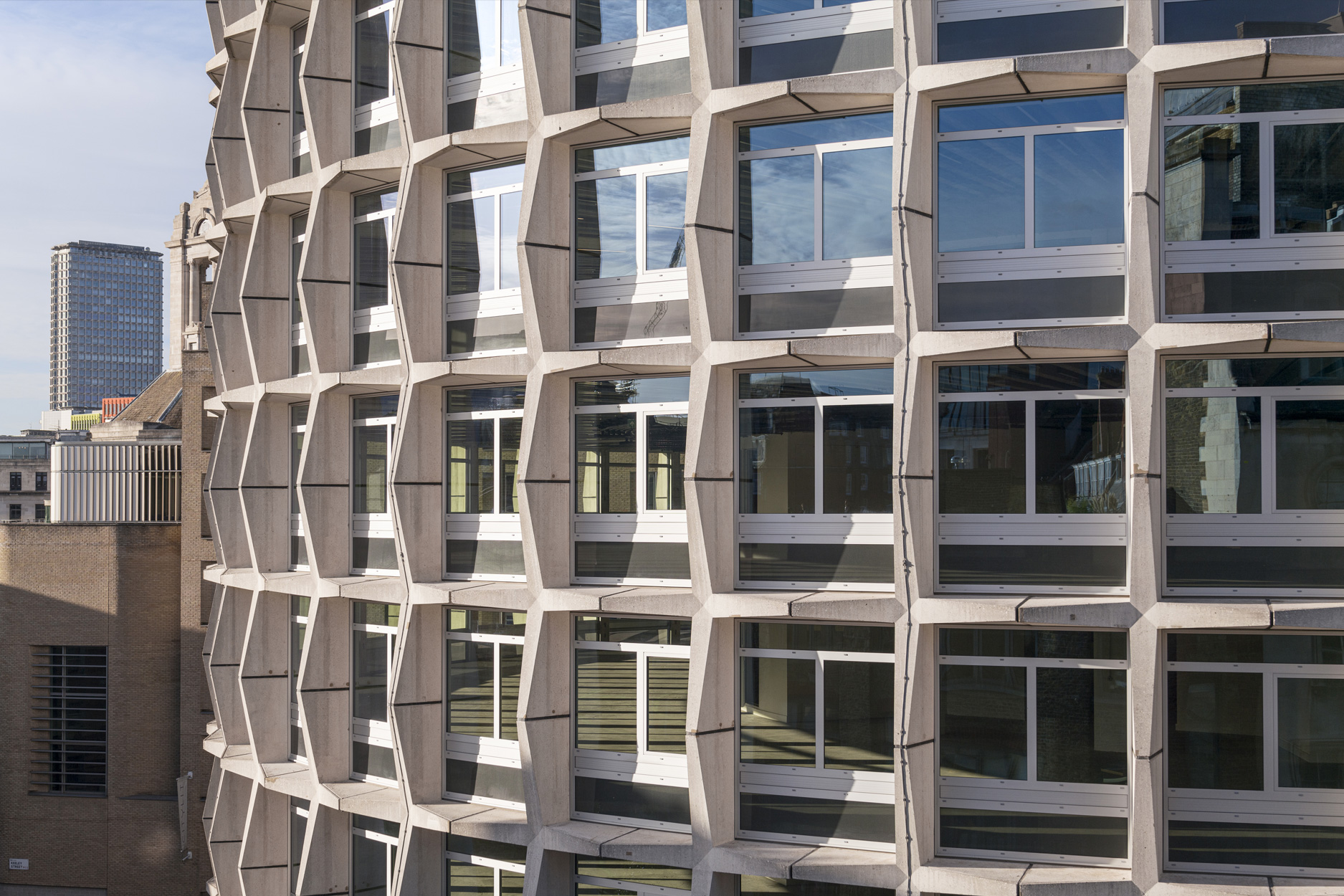
Can you spot the hexagons dotted all over Space House? It's something Tim Gledstone, the architect at Squire & Partners who led the restoration of Space House, first noticed.
He did something few people do: he looked down rather than up. While everyone else was craning their neck at the cylindrical tower, Tim noticed a thick slab of concrete floating a few inches off the piazza floor. It's actually an air vent, 21 sides by most people's count, but Tim saw ten interconnected hexagons and affectionately named it the Space Turtle. That was late 2018, and he hasn't really stopped looking since.
The Space Turtle sent him into the archives, where he turned up historic photographs of hexagonal planters in the Block building. Then the windows. "They appear as squares," he says, "but it dawned on me that they're actually elongated hexagons... The windows appear to me as hexagons, albeit subtle ones, but they're there." On the Tower, the faceted glazing sits within repeating precast cruciforms that splay into octagons wherever two meet, while the Y-shaped pillars at the base read as a ring of sliced octagons holding the whole thing up.
Tim’s hexagon radar doesn't switch off outside Space House either, running from the basalt columns at Giant's Causeway to the gold hexagonal mirrors of the James Webb telescope. "Once you create a grid," he says, "you need to find a way to break it." It's the tension he credits to Space House's original architects, Marsh and Seifert: brutal on the surface, genuinely playful underneath, if you know where to look.
Next time you're crossing the piazza, look down. The turtle's waiting.
Taken from an article in Space magazine. Ask at reception.
